
If the brain is the ultimate authority on how we move, then it stands to reason it will protectively tighten muscles to keep the body from joint actions it deems unsafe. But how the brain incorporates movement and what its preferences are aren’t always clear. But if compensated movement isn’t brought into the collective consciousness, how much can we expect to change?
Fascia can be thought of as fiber optic cable feeding information to the brain, and there are areas it seems to listen to very intently. The core is one of those places.

Training should focus more on the forces that destabilize than asking bodies slowed by the brain to speed back up. But we need more than fastidious interventions to fix dings in the body’s collective chain. At Meso Fit Boca, we consider the ripples dings leave behind that affect the entire system.
When the core is weak, the spine is vulnerable. We train the core to brace and react to destabilizing force. Bucket Theory considers the relationship between the ribcage and pelvis extremely important to training. Since both the ribcage and pelvis resemble buckets, one inverted (rib cage) stacked atop another (pelvis), we need to consider the contents of these buckets to understand why the brain goes to such great lengths to protect them. People sleep fetal because it protects the contents of these buckets, and slouching may be a protective method in the absence of core strength.


Strong core’s keep the ribs and pelvis stacked and aligned while the extremities perform reach movements. The brain green-lights all movement when the buckets align, stabilize, and create a solid torso. The core is a reflex. Drawing in, pulling the belly button toward the spine, or any other miscue pertaining to ‘setting’ the core prior to moving is incorrect. The core needs to react, not prepare. No one has dictated which joint action should be stronger; or whether the mirror opposite joint actions should be of equal strength. But from the brain’s perspective there are only two joint actions of note, reach and withdrawal, and the brain uses the core to manage both.
To reach high-hanging fruit requires length, but also the power to withdraw reach quickly should reach become perilous. The core functions as intermediary between ribcage and pelvis while the extremities move away from the spine or midline.
Bucket Theory looks at how the body creates and manages forces the world enacts on us. If torso stability is compromised, spinal rotation replaces the joint actions more suited to create movement. This creates shearing forces in vertebral disks and leads to eventual degeneration. Until silly putty is repurposed as a suitable disk replacement, we should work hard to keep the spine stable and let the extremities do their job.
Reach exposes. Withdrawal protects.
So it stands to reason withdrawal should be the focus of strength training. At Meso Fit Boca, our Signature Series of exercises elicits an adductive response, and therefore, a core response from all our exercises. We believe if the core isn’t involved in every exercise, it can hardly be incorporated into collective movements like walking outside of training.
It’s important to note that balance comes from the brain, not muscles. The inner ear protects us from falling forward with an errant alert system that reels you back the instant you lean forward. This is an important system to manipulate in training because prone position (plank and push-up) loads the core and forces it to brace the spine. But these bracing positions do not tax the obliques as effectively as they could. We need to add a rotational component to prone position to incorporate the obliques.

Looking at fiber direction, the obliques are ideally positioned to prevent torso rotation. There is also sufficient evidence to support the idea the obliques are uniquely connected to the opposing adductor muscles (See Anterior And Posterior Slings). This begs us to consider diagonal patterns as the ideal patterns to strengthen.
Undoubtedly, one diagonal pattern is weaker than the other. To assess this, get into push-up position and try to place all your weight into the right hand and left foot and lift the opposing sides off the floor. If you instantly loose balance, there’s instability in the pattern. Now try the other side. This is one of the reasons to advocate using the non-dominant hand as much as possible outside the gym. Strengthening the weaker diagonal pattern takes precedence over all else if the system is to progress.
Diagonal Pattern Holds:

Very important things happen when considering abduction an exploratory joint action like moving your foot along ice to test it. If the ice cracks and splits, the body needs to withdraw the foot quickly. The protective action of adduction should be as powerful and fast as possible, even spring like. This was evolution’s brilliant adaptation to earth’s terrain that grants the body unlimited reach with powerful withdrawal so we can retreat should the earth fight back. This is why adduction is inherently stronger than abduction.
More amazingly, every time you adduct, the core fires. This powerful coupling adds credence to the idea that adduction should remain a lasting, powerful, force or the brain will shrink your world. Yes, length is important, but if length gained is at the expense of the ability to reign it back, length becomes arduous.
Present the torso as a single, solid structure, and the hip and shoulder joints can manage any destabilizing force. Present the world an improperly trained core, one pretensed (set) before movement, and the brain’s ability to manage and properly distribute force is compromised. So the brain scratches all the activities that require a strong torso, including bucket list items.
The Bucket Workout:
Diagonal Pattern Holds
Deadbugs
Supine Rear Laterals
Prone Pullovers
Prone Rear Laterals


At Meso Fit Boca, we didn’t come up with a new way to squat, deadlift, or pushup.
We created exercises that include the brain in the quest for brawn.
We believe that the loss of function associated with aging is really a system wide breakdown caused by misalignment. And by aging, we mean merely getting older, as we’ve seen movement dysfunction in clients as early as 13 years old. This is why we cannot continue to ask bodies to perform without regular check-ups for signs of movement dysfunction. These bodies still produce movement, and some of them do so exquisitely. But we also believe that to correct this, we have to measure the associated loss of equilibrium that comes with the repetitive movements caused by sport and life.
The more profound the difference between the non-dominant and dominant sides of the body show that the body isn’t in need of MORE exercise, it needs careful attention to restoring lost power (see Absolute Power). Our 4-phase system allows each client to proceed with the knowledge that our programming cleared enough movement restrictions to allow it to proceed into more challenging phases. Our pinnacle so called “5th phase” is reassessment that allow us to build on past successes.

Our Signature Series of exercises comply with what we theorize is the brain’s Modus Operandi, which is to move clients through their worlds unharmed. We say ‘their worlds’ because until we understand the movements clients perform thousands of times a day, we’ll be of little help in improving their lives. Anyone trainers can apply more exercise, but RAMP certified trainers assess every client to ensure they apply the correct interventions to the parts of the body in most need. Once that proves fruitful, we seal in those improvements, so that our clients can explore more.
Clients don’t just have a better understanding of their body, they report more mobility moving around hectic days. And when they need to hit the gas because some days requires it, they have more throttle. Other theories center on how to tax an existing movement system. We strive to improve every clients’ movement capacity before we apply exercise, because exercise won’t work without increasing overall ability.
Think of each RAMP phase (Restore-Align-Maintain-Progress) as a way to categorize movement ability. Restoration allows us to bring the body back to its middle. Then we align the body with exercises that re-pattern the brain and allow it to move in the new space created in restoration. Once these goals are maintained, the brain allows greater expressions of movement.
Below is a sneak peak at one of our Signature Series exercises, The Lateral Push Up Walk version 1. We design and use each exercise based on how easily it is either regressed, for people lacking full extension, and it lends itself to multiple progressions. All of The Signature Series exercises are designed specifically to match each of the phases, and all are able to be progressed in suit with our goal of constant improvement.
The question of whether power gained in training is expressible elsewhere is only answered when our clients report doing things they once couldn’t. Sometimes that’s simply moving pain free, other times it means moving more often. And then there are those who seek to defy the laws of gravity whenever possible.
At Meso Fit Boca, we design programs that contribute to life outside our studio. No matter what the goal, weight loss, strength, or length, every one of them includes the ability to produce more power. To increase power capacity, we restore all joints back to their middle. This improves the length-tension relationship between muscles. We then increase power output, paying special attention to deceleration, which should be equal to, or greater than, acceleration.
Simply put, we increase power by doing powerful things. But before launching into multi-joint activity, we have to abide by the brain’s strict safety rules. The hips and shoulders need stable bases. The core should keep the ribs and pelvis stable and aligned while we create power with the extremities. The most important aspect of the exercises presented below is that they be done fluidly, not robotic or mechanically.
This is yet another example of how The RAMP Method can be applied to any goal or discipline and achieve fast results. First we have to obey the laws of gravity, ensuring each foot is capable of balancing in the absence of the other. Very few of our extra curricular activities are done bilaterally. In other words, we’re rarely producing power on two feet.
Walking is a heel toe activity, while sprinting automatically puts us on the balls of our feet. This tells us that when a situation calls for a hasty exit, we always do so on the balls of our feet. At Meso Fit Boca, we re-train the brain to pivot on the balls of the feet, since very few successful getaways start on the heel.
The idea of these exercises is to create multiple forces in opposing directions, as would likely be presented in real life. It is said that absolute power corrupts. Incorporating power exercises into our programming makes movement incorruptible. This also calls upon connections of musculature, like the anterior and posterior slings, we already know exist and have written about in previous posts.
The following workout is an example of how to get more from each set. Each exercise requires coordinating mobility and stability, and can be done individually or circuit style. Try 3 sets of 8-12 reps for individual. If circuiting, run through 3 to 4 times. This is an excellent workout when you’re in a time crunch.
Prone Rear Lateral
Step Into Press
Pushdown/Curl
Pulldown Press
ViPR Shuffle W/Press
Peruse any gym and find most six-pack seekers grinding out sets from the floor. But is the floor the most effective way to challenge the core, or is it possible the brain grants it because one of its many safety requirements are satisfied?
The brain seeks a stable spine, and the spine is most stable when horizontal on solid ground. As anyone who’s been thrown to the mat knows, the brain often wants us to stay there until whoever flipped us goes away.

But reason dictates that if the core is strong on the floor and nowhere else, the core is useless until we’ve already fallen. Crunches have proven a costly backdoor into the core because the crunch moves the spine to contract the core. This poses a problem if you believe the core’s role is to stabilize the spine, not move it. At Meso Fit Boca, we believe the core is integral in preserving the precious disk space between vertebrae that act as vital shock absorbers.
We also believe the core lives in extension. To fully appreciate this, you have to feel it. If you stand up and lock all joints and squeeze your butt hard, you should feel the core. This extension is what most people lack and need to restore if the core is to act accordingly and keep the spine stable.
Imagine full extension to be ultimate reach where every joint contributes. The core’s job is to keep the spine stable during reach or it will be reeled back. This might explain why thrill seeking in adolescence bows to common sense in adulthood, as the brain kyboshes risk whenever it’s higher than the reward. Those who defy this pay the ultimate price with multiple injuries that force the brain to withdraw further. Soon, it’s hard to justify leaving the house, going on vacation, picking up kids, or walking puppies.
Building a strong core takes challenging its role in movement, not it’s muscles. This means the core needs to be felt in ALL exercises; and the strongest cores are felt in all movement. Yes, the spine should be mobile, but it should only move upon conscious request, and should never move to compensate for other imbalances.
Planks are often done in an attempt to strengthen the core. This bracing exercise is ideal for when the core needs to hold the torso still. Since most people lack full extension, the plank falls prey to improper form. As a matter of fact, residual flexion, or bending, places undue load on the spine during plank. To prevent this the glutes need to engage. This is the only means of keeping the hips out of flexion.
The plank is really just pushup position with the elbows in flexion. Removing the wrist takes away the often heard complaint that pushup position hurts these joints. But shortened muscles won’t extend until released, and even then it’s anyone’s guess whether what’s gained in plank is useable elsewhere. But we’d be amiss without an understanding of why the plank is so effective at firing the core.
Of the balance systems in the brain, the inner ear has an important task. Filled with fluid, the inner ear alerts us to the slightest bend forward. The brain tally’s the risks of falling forward or backward and often chooses the latter because falling forward poses greater risk to vital organs. Prone, or pushup position, stimulates the inner ear and the core is, and should be, the first to respond.
Any modified version of the pushup proves the core cannot handle full extension. Seldom is this exercise progressed to the non-modified version. Discomfort in full pushup position usually manifests in the wrist, elbow, shoulder, and lower back, and is caused by misalignment. This won’t improve until realigned, which takes forethought.
At Meso Fit Boca, we reinvented the plank with designs on progressing this powerhouse exercise forward. The balance required to maintain pushup position on balls ideally places tension where it’s needed most, and the core response is undeniable.

To gain full hip extension, short and tight hip flexors need release and stretching. Only then can pushup position, or high plank, be effective. But most people maintain some degree of hip flexion in pushup and plank. This places load on the spine.
The shoulder joint and blades also pose issues in gaining full body extension. Tight latissimus, pectorals, trapezius, and rhomboids name a few. But tight triceps, biceps, and forearms will prevent full elbow extension, leaving the rotator cuff open to risk. All this causes excessive lumbar curve and weakens the core. The same techniques of release and stretch will combat this problem and create better posture, and therefore, increased extension. It’s essential that the spine is not called upon to substitute for muscle systems out of balance.
At Meso Fit Boca, planned progressions are our only means of determining that our interventions are working. We restore extension so that plank can be mastered, then it’s used in a myriad of ways to continually challenge the core’s role in reaching.

Pushups lend themselves to multiple regressions and progressions. The versatility of this exercise makes it perfect for building functional strength that’s useable anywhere and everywhere. Elevating the upper body off the floor and onto a bench takes the intensity down a few notches and serves as an excellent place to start. Stable shoulder blades will allow full range of motion in the shoulder joint. Movement of the blades throughout the pushup point to instabilities in the shoulder, core. Excess curvature of the lumbar is thwarted by contracting the glutes. This also increases the effectiveness of the core.
Once plank and pushup position are mastered, it’s time to add some balls (pun intended). Start on 4 balls so that each extremity can bear equal weight. Undoubtedly, the non-dominant side will pose the greatest inability to balance. From there, master the 3 and 2-ball versions (2-ball shown below).
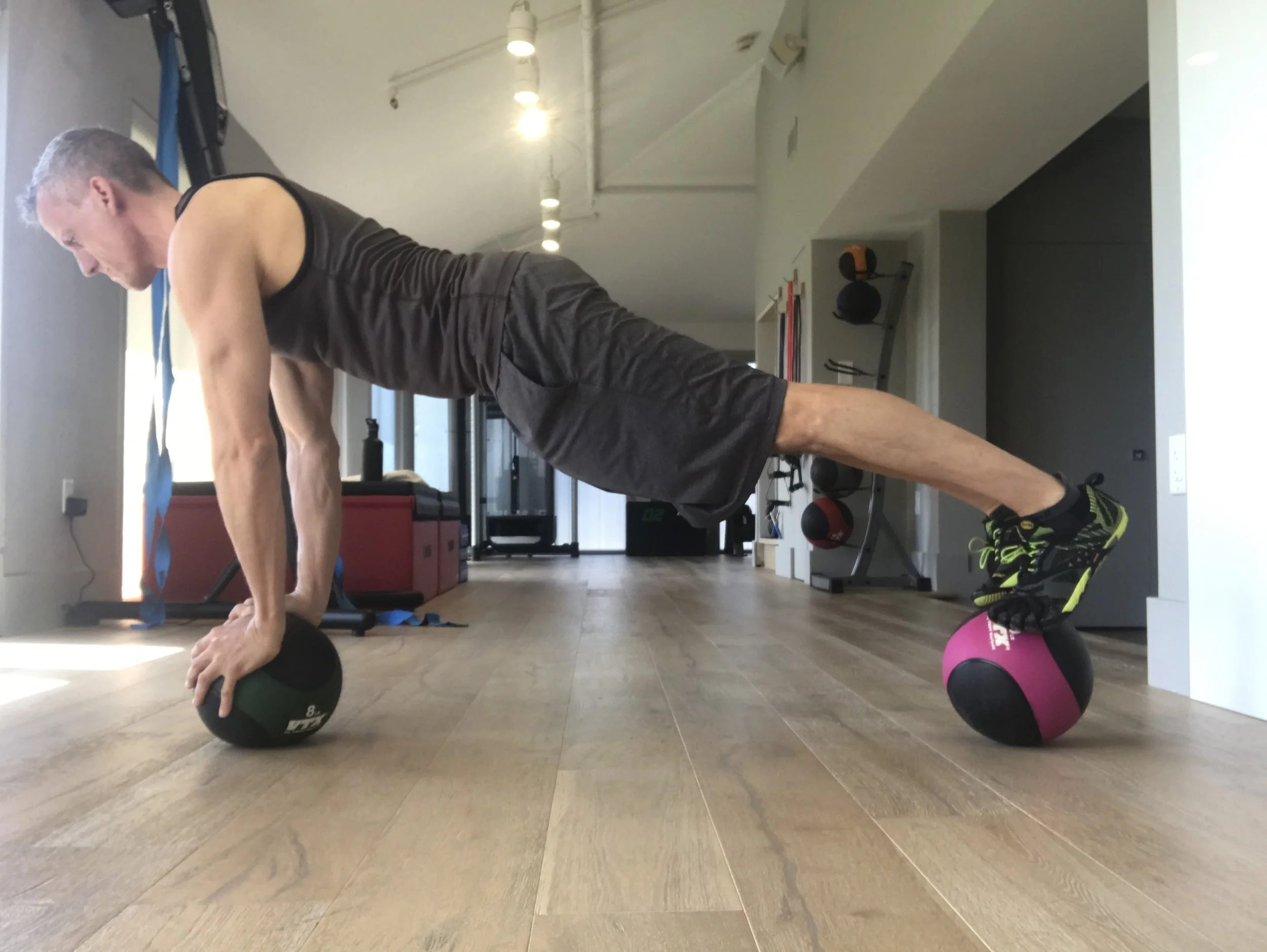
Progressing takes mastering previous versions. Once you can show proficiency in all versions, return to the 4-ball version:
Very few dislike the idea of being rubbed. Even our pets seem to fall trancelike to calm strokes. The idea of massage has always been relaxing, even deep tissue, and now we understand why. When muscles become tight with strain they don’t receive the same blood flow. This loss means that when the heart pumps emphatically, as it does during exercise, these muscles lose influence and cause misalignment. Foam rolling is the only defense against the effects muscle imbalances have on movement.
People grimace at the idea of paying for weekly massages because of the out of pocket expense. But myofascial release is necessary, and self-massage is one of the most effective tools in anyone’s arsenal. The science of myofascial release has expanded over the past decade to include much more than foam rollers. Surface area matters, which means conventional foam rollers don’t work well on smaller muscle groups like the calfs, hamstrings, erector group, and upper body muscles. Those muscles will need the smaller surface area that sticks, lacrosse, and softballs apply. Just about anything hard can apply pressure to a muscle in need of release and self massage not only strengthens the fingers, but also creates tremendous self-awareness. Sense of touch and finger strength are vital components of regular functioning.

Clavicular Pectoral Release
The use of these tools still remains opaque as most experience some form of discomfort when rolling. It’s important to know whether or not the pain is worth your time. Since everyone’s a mish-mash of muscles locked in short or long positions, each need a distinct intervention to correct. Short, or muscles locked concentrically, need to be foam rolled in the muscle fiber direction so it will grant length. Muscles locked long need sheer, or pressure against the fiber direction, so they can contract.
But rolling causes pain in both situations, which means foam rolling can produce pain with no gain. At Meso Fit Boca, we use muscle length testing to determine which muscles are locked either concentrically or eccentrically so we can weed out the dysfunction both cause. All muscles need to give equal length and breadth so they don’t cause compensation.
Muscles locked long or short are also locked out of collective movement and the brain has to take the path of least resistance to move around them. Limping is the brain’s way of eliminating any movement threatening further harm. But dramatic limps aside, gait assessment can also reveal mini limps that hint at misalignment somewhere in the body.
At Meso Fit Boca, foam rolling, or myofascial release, is an important part of every client’s program. Its enormous potential serves as the missing link between balanced length and strength. Inadequacies must be removed through techniques designed to restore the length <—-> tension relationship between all muscles. No exercise program is justified without measuring a client’s current capacity.
Meso Fit Boca uses myofascial release in accordance with the results of client assessment in order to:
Increase blood flow to over-tensed areas.
Gain momentary extensibility from muscles locked short, and contractile ability from muscles locked long.
Train the body to combat these imbalances and slowly remove them.
This technique is integral to getting out of pain or dysfunction and onto a more mobile life. There are several things to keep in mind. Exercise is adept at creating contraction under load. That load is either imposed by moving bodyweight against gravity, or using weights to influence gravity. Either way the brain needs to create both tension and release, so it’s imperative we learn how to shut muscles off while we work hard to turn them on.
Meditation, aroma therapy, passive and active myofacial release, and yoga, name a few of the ways to reconnect the brain to greater reach and to keep fascia hydrated. Releasing prior to exercise allows temporary movement from muscles locked short or long. Passive myofascial release is ideal for those who can’t stand the pain invoked by active release techniques. This is also an opportune time to practice mentally shutting muscles off, a necessity if greater body awareness is to be achieved.
Here, we seek complete relaxation of all muscles to prevent muscle guarding, which is tension created to protect from pain. In this way, myofacial release can be meditative and relaxing, two effects that combat the devastating effects of stress, both physical and mental.
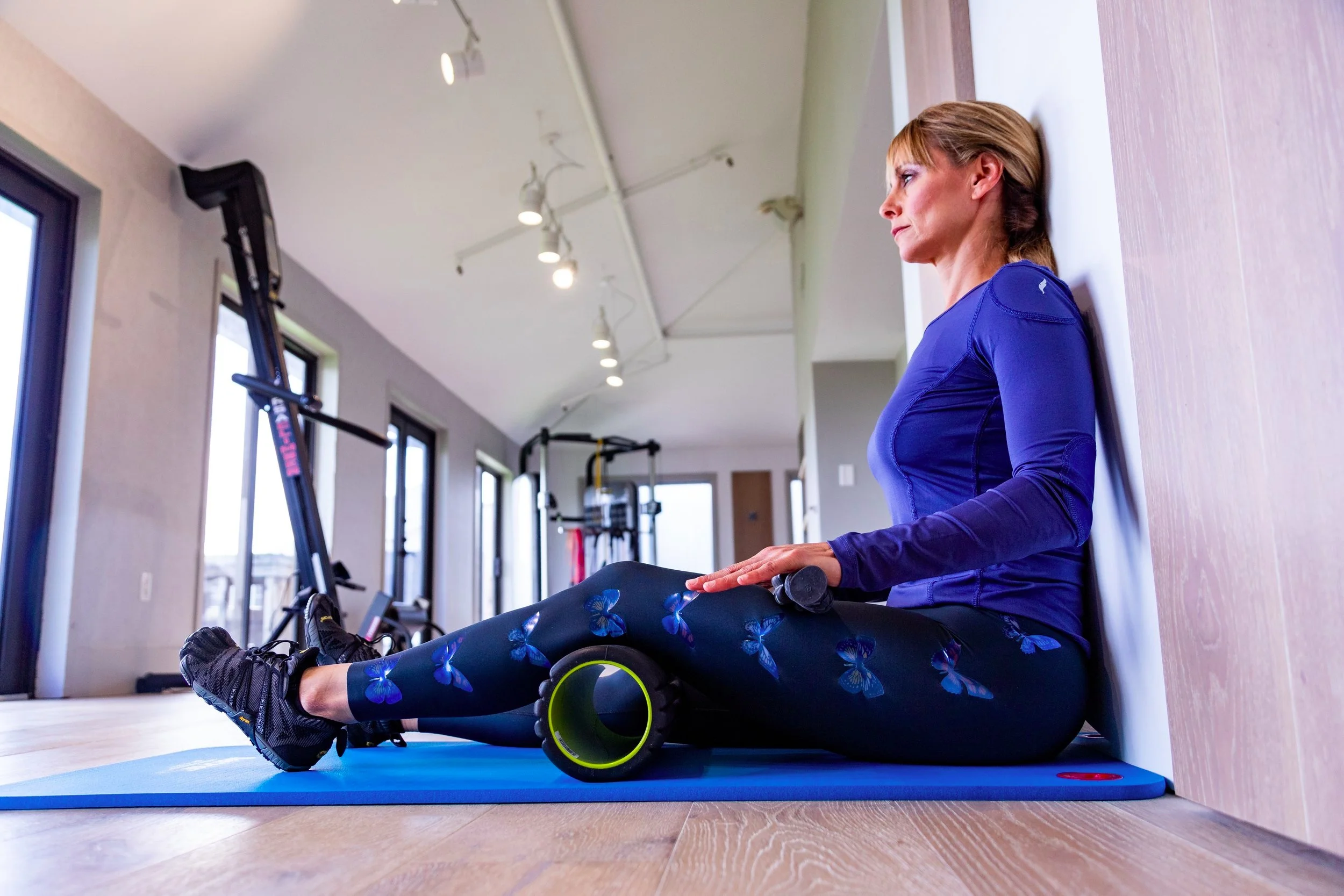
Passive Release (rectus femoris)
Active myofascial release is what most people associate with foam rolling. It uses some measure of bodyweight and the positions are often difficult for those who assess poorly to get into. This is why we created passive techniques that are more user friendly and can be recreated easily at home. Active techniques are a progression and can be used in conjunction with passive techniques as long as pain is manageable and produces results.

Active Release (rectus femoris)
More intense progressions include movement in the most tender parts of the muscle. Be careful of numbness or tingling as this is a sign of pressure on a nerve.
The ramifications of something done as many times a day as walking is tough to clock. But inefficient gait should top the priority list if improvements are to be expected elsewhere in the body. Dysfunction within this pattern worsens with increased intensity; which explains why exercise can lead to injury if we don’t have balanced gait.
Of the two phases of gait, the stance phase is responsible for 60%, and the swing phase 40%. In dysfunction, one leg may spend too much time in stance and not enough in swing, and both phases are affected by imbalances, which shorten stride. Stance phase begins with heel strike and swing phase begins when stance ends.
Gait pattern is tricky to understand because so many subtle changes occur throughout. At Meso Fit Boca, we’ve whiddled down the important parts relevant to training.
Gait Pattern:
1. Initial contact begins the moment the heel touches the ground.
2. Plantar flexion is allowed by eccentric contraction of the tibialis anterior, extension of the knee is caused by a contraction of the quadriceps, flexion is caused by contraction of the hamstrings, and flexion of the hip is caused by the contraction of the rectus femoris.
3. In foot flat, or loading response phase, the body absorbs the impact of the foot by pronating. The hip moves slowly into extension, caused by a contraction of the adductor magnus and gluteus maximus muscles.
4. Midstance is when the hip moves from flexion to extension by contraction of the glute. During this phase, the body is supported by one leg. At this moment the body begins to move from force absorption to force propulsion forward.
5. Heel-off begins when the heel leaves the floor.
6. During toe-off, or pre-swing phase, the hip becomes less extended. Early swing phase extends and then flexes the hip due to contraction of the iliopsoas muscle.
7. In the midswing phase the adductors flex the hip by contraction of the adductors, and the ankle becomes dorsiflexed due to contraction of the tibialis anterior muscle. The knee flexes then extends due to contraction of the sartorius muscle. The quadriceps contract and cause extension.
8. Late swing is the deceleration phase and begins with hip flexion, full extension of the knee, and neutral position of the ankle.
Given this information, shouldn’t any dysfunction in gait be corrected first? This is relevant to training because until restored back to their middle, progressing joints and the muscles that surround them is impossible.
How clients walk in and around their worlds tell stories hinted at during assessment, when we see the effect of moving restricted for any length of time. Of the repetitive movements done daily, dysfunctional gait poses as much risk as picking heavy things up and putting them down. Add the two, and the clock ticks toward potential breakdown.
Our first attempt to correct gait is with Consistency In Step. This is achieved when brain and body synchronize and every step lands exactly as expected. Inconsistency makes the brain hesitant to deliver power because energy is diverted to keeping imbalanced feet from toppling the entire system.
You should be able to hold yourself still in all phases of gait:


Keep in mind that at no time in gait are both legs loaded at the same time or in the same way, and the same applies when training. To truly simulate gait, both legs cannot be loaded. This is contrary to the entire gait pattern that relies on a system that can tense and relax when needed to create ambulation.
Depending on which phase of gait you suspect needs attention, mimicking them in certain stances while performing an upper body push, pull, or push/pull exercise will strengthen weak spots. Only then can we apply local thinking to global problems. Until the dysfunctional part or parts of gait are revealed, there’s no way to know which interventions are correct.
Jackie Week 1
Jackie Week 2
The core is vital in all movements, but walking shares particular importance. We need the core to be its strongest in standing, but first we have to build stronger cores on the ground with intent on taking that strength into standing. Seated populations lack the full extension required to make exercises like planks effective. Time will tell whether bad planking is better than no planking, but any exercise that incorrectly loads the spine is dangerous to our long-term movement health.
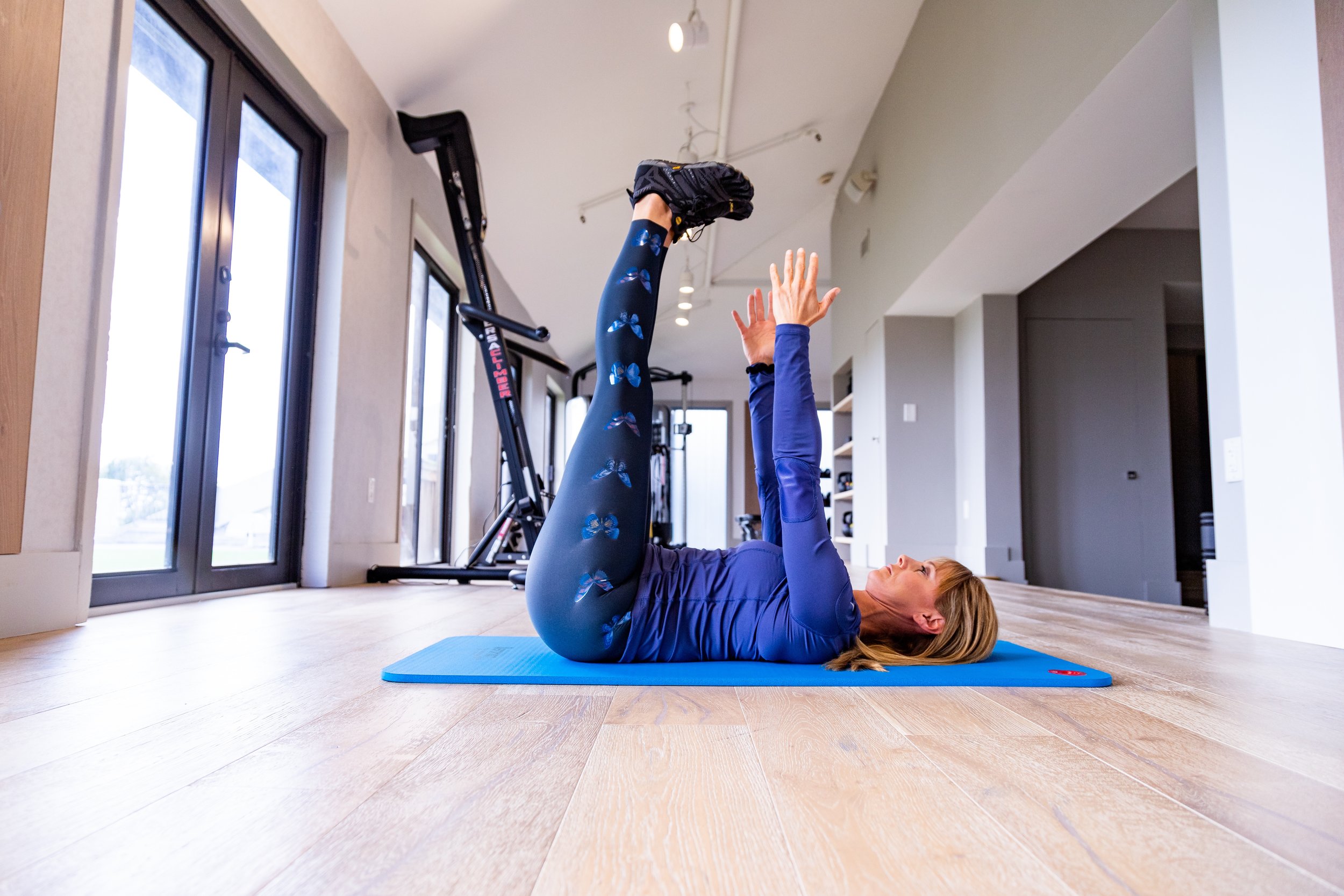
But there are exercises that can work the vital muscles involved in gait and illicit deep core responses. Deadbug is the exercise we use at Meso Fit Boca to prep our clients for more complicated movements. It’s single-leg, creates arm swing, and requires unwavering stability in non-moving parts.

Deadbug Pattern- This beginning stance is meant to be held passively, with little to no strain or movement in the spine. Clients that have trouble in stance need to regress the exercise. The spine and non-moving arm and leg need to remain still throughout.

The other way to really feel side differences in gait is to do a Single Arm Farmer’s Walk to see how gait changes when the different sides are loaded. Whichever side changes gait the least would be representative of how you carry life. In other words, whichever kettle feels easiest to carry, never mind what changes occur, would be indicative of a side that carries groceries while the other side manipulates keys, cellphones, or multiple kids. If we look for things that clients do absentmindedly every day, we can thwart the effect repetitive movement has months, sometimes decades, later.
Walking is one of our least intense activities, or so it should be, and any fault in gait can have devastating effects. It’s easy to stop running if your knee hurts, but if you can’t walk life screams to a halt. To achieve something different takes applying tactics the brain can use to navigate us through life. Consistency In Step allows increased throttle and gives us more brake!
Oblique means slanted, neither parallel nor at a right angle. It’s also defined as not straightforward, devious, and underhanded.
The internal and external obliques usually evade our crunched attempts at core training unless the spine is twisted off center to force these powerful torso stabilizers to fire.
So why is it so hard to include these muscles into exercise unless we side plank ourselves to death, which has yet to prove its efficacy in creating more stable torsos? We’ll explore why these core muscles might be the key to restoring power while stabilizing your spine.
The biggest problem in creating stronger cores is how to get the strength we gain on the floor, where the spine is the most stable, into standing, because the two rarely connect. We’ve had some luck using ½ kneel and full kneel stance, but not to the point where the core is strongest in standing.
A significant implication of current theory is that the brain cannot translate the isolationist approach to exercise into the whole body movements it needs to perform daily. We need to get on the same page as the brain that doesn’t have a representation of a bicep stored in its neural net, only the movements it contributes to.
Shifts in thinking haven’t necessarily changed the way people train, as a matter of fact, so much training is still rooted in old bodybuilding theory of isolating parts hoping the whole will be greater.
But haven’t crossfit and other whole body movement theories shown up and are producing results?
Good question.
What four things do all Olympians, professional athletes, and other freaks of movement do best?
They flex, extend, control rotation, and change direction better than anyone. The best player on any field does this better than their counterparts who have to defend against an onslaught of movement we need to see in slow motion to really appreciate.
This will continue to be the greatest folly of a seated, predominantly flexed, population. Lack of full extension causes rotation from where it causes the most damage. This is why tight hip flexors and protracted shoulders are implicated in the question mark posture so many assume as they age.
So applying giant, sweeping, power movements to flexed populations sounds risky at best, despite everyone knowing someone who dated someone’s cousin who said their brother knows a coworker who lost 8,000 pounds doing (insert fad here).
To arrive at a more sound application of current theory, we all sit at a crossroads. Turn left toward old theories repackaged under different logos; or plow right toward the application of a more sound theory of what moves us.
Slings are chains of muscles, fascia, and ligaments. For example:
The Anterior Oblique Sling is the coupling of the external and internal oblique connecting with the contralateral adductor muscles via the adductor-abdominal fascia.
The Posterior Oblique Sling is the coupling of the latissimus dorsi, glute maximus, and the interconnecting thoracolumbar-abdominal fascia.

The RAMP Method at Meso Fit Boca incorporates the brain, core, and fascia, into exercise. The Lunge Into Row and Supine Rear Lateral below are just two examples of exercises that address real life issues. Clients report unrestricted movement that allows them greater exploration. We provide clients with strength that’s applicable anywhere in life, not just the gym. Our method restores parts of the body downgraded by trauma, excessive use, or injury. We then use our exercises to re-pattern the brain to move in accordance with sound theory.

Lunge Into Row targets the posterior sling.
Supine Rear Lateral Begin

Supine Rear Lateral End

If you’re like millions of Americans, you struggle with weight. How much is ideal, where it gathers, and how to get rid of it top most people’s list of health concerns. At Meso Fit Boca, we have answers.
First, let’s discuss metabolism; that wonder word that has us playa-hating the ones who can eat anything and pay no consequences. But blaming metabolism is like blaming radar for why you keep getting speeding tickets. Metabolism is merely a measurement of how quickly your body converts fuel into energy. But just like exercise, metabolism’s are subject to evolutionary responses and starvation may lead to hoarding fat and burning muscle.
Let’s assume that burning more calories than you take in doesn’t always equate to fat loss. This theory is called calories-in vs. calories-out, and is the basis for diets that restrict food intake.
We inherit our metabolism from generations of humans that gained weight when food was plentiful, then lost it when food wasn’t. We might better understand weight gain as a natural consequence of calorie restriction, not the failure of the dieter.
The human metabolism comes from a dizzying lineage of cave-people trying to survive perilous seasons full of predators and other hungry cave-people. Once we were able to store food and protect it, people formed communities. Before refrigeration, people ate what was fresh that day and they shopped daily in markets whose financial solvency depended on delivering the freshest food. We regale at the health benefits of olive oil but fail to realize that the oil they’re referring to was made daily from olive pits littering the countryside, not the oil in your cabinet with a questionable sell by date.
Today we have completely lost touch with that visceral connection to food where smell, touch, and sight, determined what was safe to taste. Today, food companies manipulate these senses leading people to believe everything should taste good, which usually translates to lulling the brain with salty, sugary, fatty foods.
We adopt a scientific approach to weight loss and give the body exactly what it needs every day; because if we don’t pay the body back for the things it has to do every day, hour, minute, and second, the brain hoards calories. So follow a few simple evolutionary and biological rules:
1. Eat enough.
Diets should provide the body what it needs to create nutritionally sound foundations to build upon. These are the nutrients your body receives through foods, not supplements. The last thing anyone needs is the brain to see weight loss as a threat.
Homeostasis is the brains ability to keep all systems functioning normally. Weight losses and gains are stresses to the brain hell-bent on avoiding starvation. This might account for initial weight losses followed by plateaus that usually cause a return to “normal” or even binge eating.
It takes the proper fuel to run efficient metabolisms and the body reverts quickly, so the key is consistent nutrient loading throughout the day. This allows the body to keep up with our persistent pace. Missing meals is stressful to an expectant body. We can’t push cars farther than we fueled them, but the body easily burns muscle for nutrients if restricted too harshly, and metabolisms slow with muscle loss.
To guard against this we need 2 big doses of nutrient-rich vegetable smoothies at key times, morning and night, with 2 to 3 smaller nutrient dense meals between. We also need to account for every loss and gain through metrics that tell us what course adjustments will keep the body moving forward.
If you’re accustomed to eating huge bowls of greens (collard, mustard, spinach, and kale), herbs, turmeric, celery, cucumber, black-eyed peas, lima beans, and wheatgrass, carry on. For those who relish the thought, blend them into a smoothie adding whatever fruit tempers the powerful flavors you might not be used to.
2. Move enough.
When muscles tighten, they get locked out of movement. The body cannot coordinate and therefore cannot burn the calories needed to promote fat loss. This causes the accepted notion that more is better, when in fact, more just wears down a worn down system. It either breaks or trudges along goalless.
Bodies riddled with imbalances need recovery, balance, and stability before attempting to progress. This takes constant check-ups for dashboard warnings that the system turned toward a dead end.
3. Before moving, make sure more of you moves.
In dog-parks and playgrounds, kids and puppies run to exhaustion, stop, rest, then run to exhaustion until all their stored energy is depleted. Our cardio training should mimic this as often as possible, but is only valuable to balanced, adequately fueled, and fully recovered bodies.
To keep the scales tipped toward burning fat as fuel instead of muscle, we have to fight harder the keep the muscle that wastes away with inactivity and age. This is why strength training may be more effective at burning fat than cardio. More muscle means more calories are burned at rest because muscle is extremely metabolically active.
Losing weight doesn’t have to be frustrating. Don’t wait another second spinning your wheels trying to figure out what works. Meso Fit Boca takes the guesswork out with programs that achieve sustainable results fast.
,
Where does balance come from?
Proprioception is a fancy science word for body awareness. This is how you know you’re on dry land and not in water, are at home and not in a box, and why it’s very hard to move you to an undisclosed location while you sleep. Increased proprioception means we keep neural connections live and flowing with information for the brain to use. Issues arise when the brain is overwhelmed with work and has a shortage of workers. When this happens, the brain loses the ability to do things that were once commonplace. (Remember spinning to nausea on a g-force carnival ride after 12 beers and 3 corndogs then running a ½ mile home because you’re two hours late for curfew?) Me either.
If you imagine the brain as a security guard with the option of watching one big screen displaying the entire property, or many screens allowing more detailed examinations of bloodspots and shadows, the preference seems clear. This is not unlike how the brain uses proprioception to move. When it comes to fluid movement, the more information the better. Unfortunately, balance and proprioception fade with age, as does our ability to move. But there are ways to prevent this.
To maintain balance we have to be balanced. As Zen as that sounds, it’s not far from the truth. Imagine you have imbalanced tires. The car drives, but pulls to the right or left. Now misaligned, it creates drag and is much less fuel-efficient. Over time, the tires wear uneven increasing the chance of blowout. But that’s hardly the only problem. The struts, shocks, wheel wells, brakes, frame, and any number of other things are threatened by the imbalance. The car will have to work harder and consume more fuel to get the same done, and this worsens unless it’s realigned.
Now imagine a muscle is off. This happens when a muscle adaptively shortens or lengthens in response to repetition. Do something enough times and the brain adapts muscles to the length or breadth demanded most. This is why we need to work change of direction into our training.
The RAMP Method creates directional changes using the pivot, or rotation on the ball of the foot. Pivoting is essential to rotating the body, as doing so from anywhere else opens us up to compensation. The shoulder joint is also a fantastic place to create massive force, yet few lack the requisite reach to create such power.
Creating rotation from the joints best suited remains essential. At Meso Fit Boca, we believe rotating from the spine or creating any force with this structure is contraindicated. Rotation is a powerful force that when harnessed creates the kinds of athleticism we are in awe of and wish to emulate. But we are warned by the likes of Sahrmann and McGill that the spine needs stability above all else.
So what is it that athletes tend to have that we lack?
Balance.
It might be a stretch to say only imbalanced bodies injure. But if the balanced body is destabilized, it shouldn’t topple without blunt force. Ask any quarterback, goalie, or sprinter, and they’ll agree if something is out of whack, production suffers. Most professional athletes have body workers working around the clock on their recovery.
Notice I didn’t say training.
Although training is paramount, if the body cannot recover fully from performance to performance, it cannot sustain optimal levels of output. Diet is helpful, but only when applied to fully recovered bodies. So how do bodies become balanced?
Balance is a lot more nuanced and cannot be applied to single situations. Physics tells us if you keep falling off the earth, something maybe wrong with how your body relates to the laws of gravity. When athletes dazzle us with feats across fields of ice and snow, we see perfectly balanced bodies adapting to multiple destabilizing forces. Can you imagine being crosschecked and come out with anything less than permanent brain damage?
So why can they and we can’t?
Each client presents a lifetime of movement. Some of that movement, depending on the amount of trauma the body sustained, is compensated. To the extent that it’s compensated, movement integrity suffers and is replaced with uncoordinated movement. This body will produce very little power but will still produce. Now imagine taking this body onto a field, court, or mall parking lot and you’ll see why orthopedists and physical therapists aren’t in low demand.
But to say our idols walk away unharmed is ignorant as any pro-athlete will tell you the price for waging daily war on their bodies is tagged high. As the long-term effects of this lifestyle become more and more apparent, we’ll be able to learn more about what happens to those of us focused on recovery and balance.
Our focus is looking at each client and asking; what would make them better? To answer, we have to know what the body in front of us is capable of producing. Overloading an imbalanced body with more work is completely counterproductive and counterintuitive to the brain. Exercise becomes endless beatings applied to a misaligned body.
At Meso Fit Boca, our assessment answers simple questions as we detect what might hinder your progress. We’ll explain what we find and how to fix it. We do not place demands on misaligned bodies until they show an ability to align; and we cannot progress any client without proof our interventions are maintained from week to week. We do that with constant check-ups to make sure our programming is working. If it isn’t, we know early, and make course adjustments that get you back on track.

Let’s talk about how we apply the four phases of our method: Restore, Align, Maintain, and Progress to clients. The RAMP Method shouldn’t be considered linear, it’s possible to restore one part while the rest of the system is being aligned or maintained. The question is whether or not to attempt progressing systems that don’t show dysfunction, i.e. if the legs show no signs of restriction, can they be progressed while the upper body is being restored?
The simple answer is that no system can progress while a joint is still being protected or hasn’t been re-integrated into the system. This is the type of isolationist thinking we’re hoping to avoid. Our job is to progress those that present minimal or no restriction. But this doesn’t mean our clients have to sit on foam rollers waiting for the day they can take a HIIT class.
The RAMP Method’s intent is to get people thinking about the list of available musculature the brain has to work with. When given a task, most think about the task, add up the materials available to complete the task, check the desired outcome, and decide whether or not they can proceed. No one attempts to build a shed with two nails and a pile of sticks.
We get this mentality from the brain because this is exactly what it does when you think it’s a good idea to snowboard, golf, or garden. But the list of resources dwindles when the brain is faced with muscles caught in skewed length-tension relationships with their counterparts.
Muscles happen to be fiendishly simple. They lengthen or contract. That’s it. The importance placed on the muscular system may be comparable to crediting your tires for powering your car. They certainly add to the experience, but they ‘re not necessarily why the car can move. Tom Myers, in Anatomy Trains, tells us the biomechanical view, that compartmentalizes human movement into the same category as coils and camshafts, ignores the seamlessness fluidity that accompanies perfectly orchestrated movement.
We need to stop thinking mechanically when it comes to human movement.
The Biotensegrity theory states movement occurs within a fascial matrix that forms a system of tension. The bones float within this matrix creating relationships of discontinuous compression that connects through the whole system.
“A model based on Tensegrity…may also be utilized to demonstrate the structural integration of the body. All our previous concepts of biomechanics of the body will have to be reassessed in relation to this model and our therapeutic approaches to the musculo-skeletal system will have to be revised.” ~ Stephen Levine


