
“The upper trapezius muscle, which is the upper component of the force-couple that controls the scapula, can be more dominant than the lower trapezius muscle. The trapezius muscle adducts and upwardly rotates the scapula, but the upper portion of the muscle elevates the shoulder while the lower portion depresses it. Excessive elevation of the shoulder is attributed to the dominance of the upper trapezius and a failure of the lower trapezius to counterbalance this action.” Shirley Sahrmann
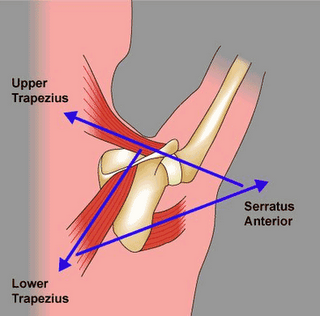
Skewed upper/lower traps need immediate attention and is an ideal place to apply Release-Stretch-Contract protocol. The upper traps often present as short and tight, especially in desk jockeys, carpool moms, and anyone seated for any length of time. This muscle has attachments that can affect the scapula, neck, and shoulder. Conversely, the lower traps can become long and tight and lack contractile ability. To keep the shoulder blade in its middle the upper and lower traps form a force-couple, or a synergistic relationship, where if one is off balance they both suffer dysfunction and create imbalances elsewhere in the region.
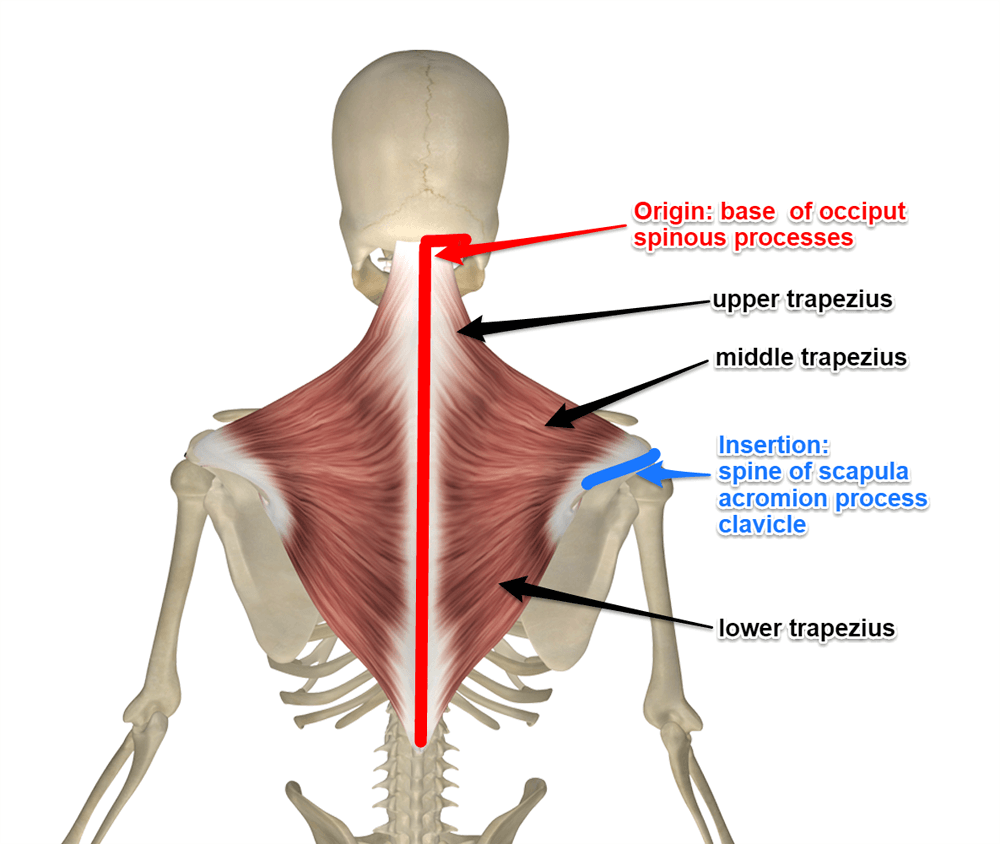
RELEASE: The upper trapezius using a lacrosse ball. Start close to the spine and move outward toward the shoulder joint.

STRETCH: Getting length from this muscle requires depression of the shoulder blade or contracting the lower trap to get the upper to lengthen. Assume the position below and depress the shoulder blade and hold for 30 seconds to 2 minutes.

CONTRACT: Use the exercise below to contract the lower traps after releasing and stretching the upper traps. This will improve the force-couple over time and correct dysfunction therein.
PROGRESSIONS:
What’s the best way to get lean and strong fast?
Breathe deeper.
The breath has been the focus of every health discipline, and when unabated, mindful breathing calms us, makes us think clear, and assists in fluid, graceful movement. Increasing breathing capacity begins with releasing anything and everything that restricts full, oxygenating, breath.
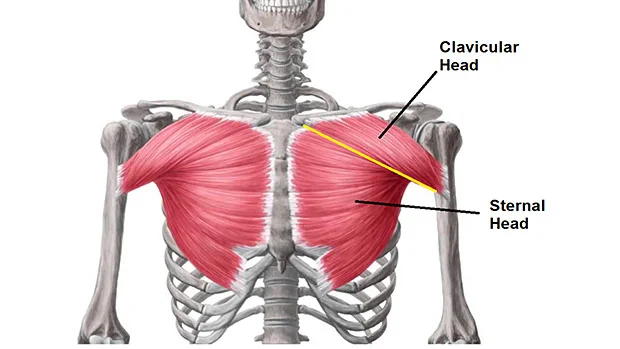
When the pectoralis major (chest) muscle is short and tight it causes slouching, excessive internal rotation, and restricts expansion of the ribcage. While how to breath is still debated, muscles with ‘strap-like’ features can, and will, restrict breathing when dysfunctional.
The clavicular head of the pec major is of particular concern because when tight, it affects not only breathing, but will restrict the shoulder and its ability to externally rotate. The attachments along the clavicle (collar bone), and the humerus, implicate this muscle in breathing, postural, and shoulder dysfunctions.
RELEASE: Place a rolling stick or lacrosse ball against the wall and put downward pressure on the clavicular head of the pec major. Once the tissue is pinned, slowly try to externally rotate the arm. Move the stick or ball inward toward the sternum and repeat.

STRETCH: With the arm held at a 90 degree angle lean against a wall and slowly lengthen the pectoralis major.

CONTRACT: Use the Grid Stick or ball as a pivoting point to find more external rotation.
This progression brings in additional core, coordination, and diagonal patterning.
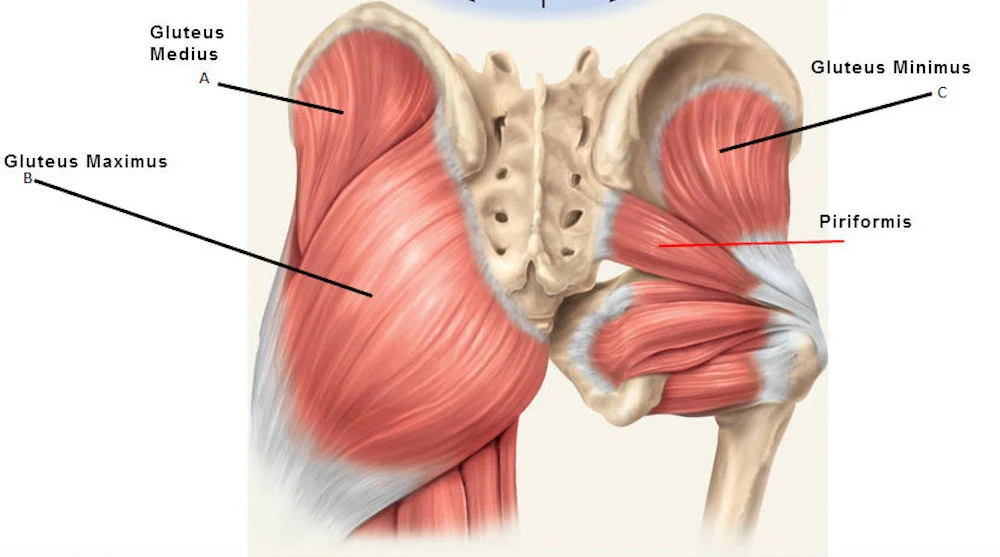
At Meso Fit Boca, we strive to incorporate as much of the brain and body into every exercise because we know the body is connected in ways traditional isolationist training doesn’t address. The bridge is arguably one of the best ways to incorporate the glutes into exercise. It’s also a great way to train in full hip extension, which strengthens the core’s anti-rotational strength ideal for creating a stable spine in all movement.
The instability created when doing the single leg and arm versions are ways to progress these exercises once the double arm and leg versions are mastered. The exercises below allow multiple variations. Always start with the version that allows the best form. Lack of proper form in any progression evidences the brain’s rejection of the pattern; regress and establish proficiency in the previous pattern before progressing.
Bridged Alternating Press
Bridged Pullover
Bridged Fly W/Stable Side Hold
Bridged Tricep Extension (single leg shown below)
Bridged Rear Lateral W/Stable Side Hold
Progressions:
Any single leg version (examples below)
These can be done in a circuit, traditional 3 sets of 8-12, or added to a current program.
PROGRESSIONS:
When the foot and ankle are off balance it provides ample evidence that dysfunction looms above. The footpad, or bottom foot, is rich in nerve endings that send proprioceptive feedback to the brain with details of the terrain. Simply put, the brain is very interested in hearing where the foot stepping and landing.

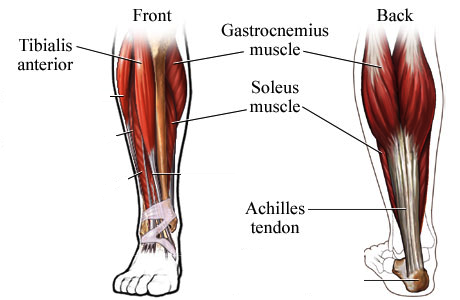
Paved roads and walkways, and consistent step-height, pose significant threats to ankles designed over millions of years to cope with multiple changes in pitch and texture from one step to another. It is questionable whether any intervention applied to dysfunction above these two structures can be fruitful without simultaneous correction of issues in the foot and ankle. Tight gastrocs, or calf muscles, restrict the ankle and create imbalanced arches in the foot. This leads to power loss, overuse injury, and compromised gait (walking).
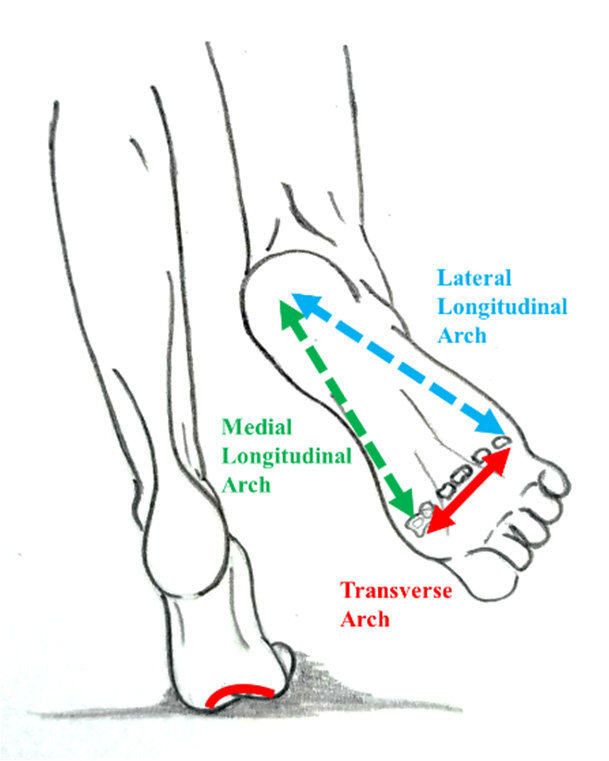
Creating more balance between the arches starts with following the Release-Stretch-Contract protocol below because the arches play a major role in all movement including but not limited to:
Supporting all bodyweight
Balance
Absorbing shock
Transferring ground reaction forces
Compensating for malalignment
The musculature between foot and ankle, ankle and knee, and knee and hip, function together to provide shock absorption and critical balance to the rest of the system. Instability in the ankle points to imbalances in the calf muscles, and the opposing muscle, the tibialis anterior. When the calves shorten due to over plantarflexion, the tibialis anterior is weakened. The calves need to grant extensibility in order to get the tibialis anterior to contract and balance the delicate foot equation that doesn’t end there.
For now, we’re just concerned with creating greater dorsiflexion.
(In later posts, we’ll explore other imbalanced equations such as long, over-stretched lateral gastroc and peroneals, and short and tight medial gastrocs, that also create instability in the foot and ankle.)
Protocol: Perform three rounds of each, aiming for increases with every round.
RELEASE: GASTROC: The idea is to place the meatiest part of the calf on the stick, find a tender spot, pause, relax, breathe, and move slowly from dorsiflexion (where the calf is forced to lengthen), to plantar flexion where a short and tight calf will find relaxation, or the least amount of residual tension. Find 3 different spots in the calf that feel tender and perform 10 pull and points of the foot (dorsi-into-plantarflexion).


STRETCH GASTROC: Because you stand into this stretch, some measure of bodyweight might get dumped into the other leg, be sure the heel always remains in contact with the ground. Advance the foot forward as the muscles and fascia begin to relax and be conscious of any flexion occurring in the hip and/or knee that result from over-stretching the calf. This takes time, patience, and frequency to see changes above and beyond what is achieved during a session.


CONTRACT INNER ARCH:
Slanted Calf Raises- Lift the heel only as high as perfect form dictates. Any rotation or bending of the knee is a compensation and needs to be controlled.


CONTRACT TIBIALIS ANTERIOR– Pull the foot as evenly and as far into dorsiflexion as possible while maintaining good form.


Meso is a biology prefix meaning middle. After age 30, doctor visits associated with some type of movement dysfunction top the list of emergency-room complaints. At Meso Fit Boca, we believe that’s because faulty soft tissue, or the brain’s software, is running on faulty programming. Young or old, previously injured, tight, performance athlete, or soccer mom, The RAMP Method is designed to bring the body back to when it moved best.
When it moved flawlessly.
The point where it moved completely aligned in its middle.
Any lack of joint range of motion forces the brain to borrow movement from elsewhere, usually the spine. Losses in hip and knee range of motion, coupled with restricted dorsiflexion of the ankle, add up to moving compensated, where the risk of injury increases. To get the body to move in its middle is no easy task. Overall improvements in daily movement can only occur with conscious awareness of prevalent side-dominance issues performed throughout the day (like brushing teeth, shaving, or eating with the non-dominant hand).
People tend to use, and practitioners tend to administer, corrective exercise long after it produces the desired result; which is to relieve pain, realign joints, and make the body function better outside of training. Corrective exercise should produce instant results. Done too long, they may cause the imbalance they seek to correct.

To improve overall movement takes creating new space to move in. Restricted feet and ankles impede the progress of all other joints and any intervention administered above them turns into a dead end. Because the foot and ankle bear all bodyweight, they need to be prioritized and any dysfunction cleared. The following exercises should be done after adequate dorsiflexion restoration (See Release-Stretch-Contract: Gastroc/Tibialis).
The Meso-Style Workout: These multi-joint, multi-directional movements require balanced feet and ankles capable of adequate dorsiflexion. Extending out of a lunge or step-up in the forefoot loads the knee and is the result of faulty weight distribution. Forefoot loading leads to knee, hip, and ankle issues and should be avoided. The ankle should remain dorsiflexed through all phases of hip and knee flexion and extension unless otherwise specified.
All exercises can be added to your existing plan and added as 3 sets of 10, or circuited with round length and exercises done according to fitness level and available equipment.
Step Up Into SDL (single leg deadlift) W/Single Arm Curl/Press
Landmine Reverse Lunge Into SDL W/Single Arm Curl/Press
Reverse Lunge Into Cable Rear Lateral
Single leg Dorsiflexed Around The World
At Meso Fit Boca, our Release-Stretch-Contract protocol uses corrective techniques to pull joints affected by muscle imbalances back to their center. The rectus femoris is of particular concern because as a hip-flexor, its attachments cross both the hip and knee, two joints whose proper alignment are integral in producing fluid, efficient movement, and avoiding injury.

Dysfunction in the rectus directly affects the core’s ability to stabilize the spine and leads to compensations that change posture over time. In the coming months, we’ll map-out common dysfunctions that cause imbalances and show how to correct them with Release-Stretch-Contract protocol.
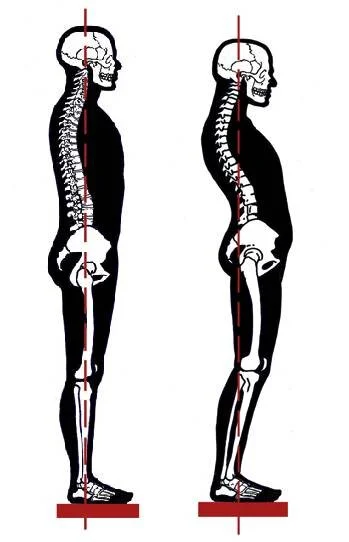
The rectus femoris adaptively shortens with excessive sitting (or flexion) throughout the day. Add the imbalance caused by sleeping fetal (more flexion), and you’ll see why assessing these imbalances, and correcting them, takes more than the typical work done in a gym. When the rectus shortens, the body cannot achieve full hip-extension because the glutes, the muscle opposing the rectus, has given up length to account for the short rectus (and other short hip flexors).
The glutes will then be in need of contraction. But lengthened glutes cannot just start contracting without the requisite room to do so. This room is created when the short rectus gives length. This point cannot be understated as any attempt to contract a lengthened glute without prior rectus release and stretch will likely cause compensation in the lumbar spine or a cramp in the hamstring.

Release-Stretch-Contract Protocol: Rectus Femoris
RELEASE the Rectus Femoris- apply pressure to the muscle so that it will grant the necessary extensibility required of the next step, which is to ask the brain to use that momentary extensibility to grant further length with the stretch (below)..
To STRETCH the rectus, aim for passive hip extension, not excessive stretch. If felt in the lower back, regress the stretch to where you can achieve full extension by lowering the bench. Do not progress until passive hip extension is achieved and can be held for longer than 2 minutes.

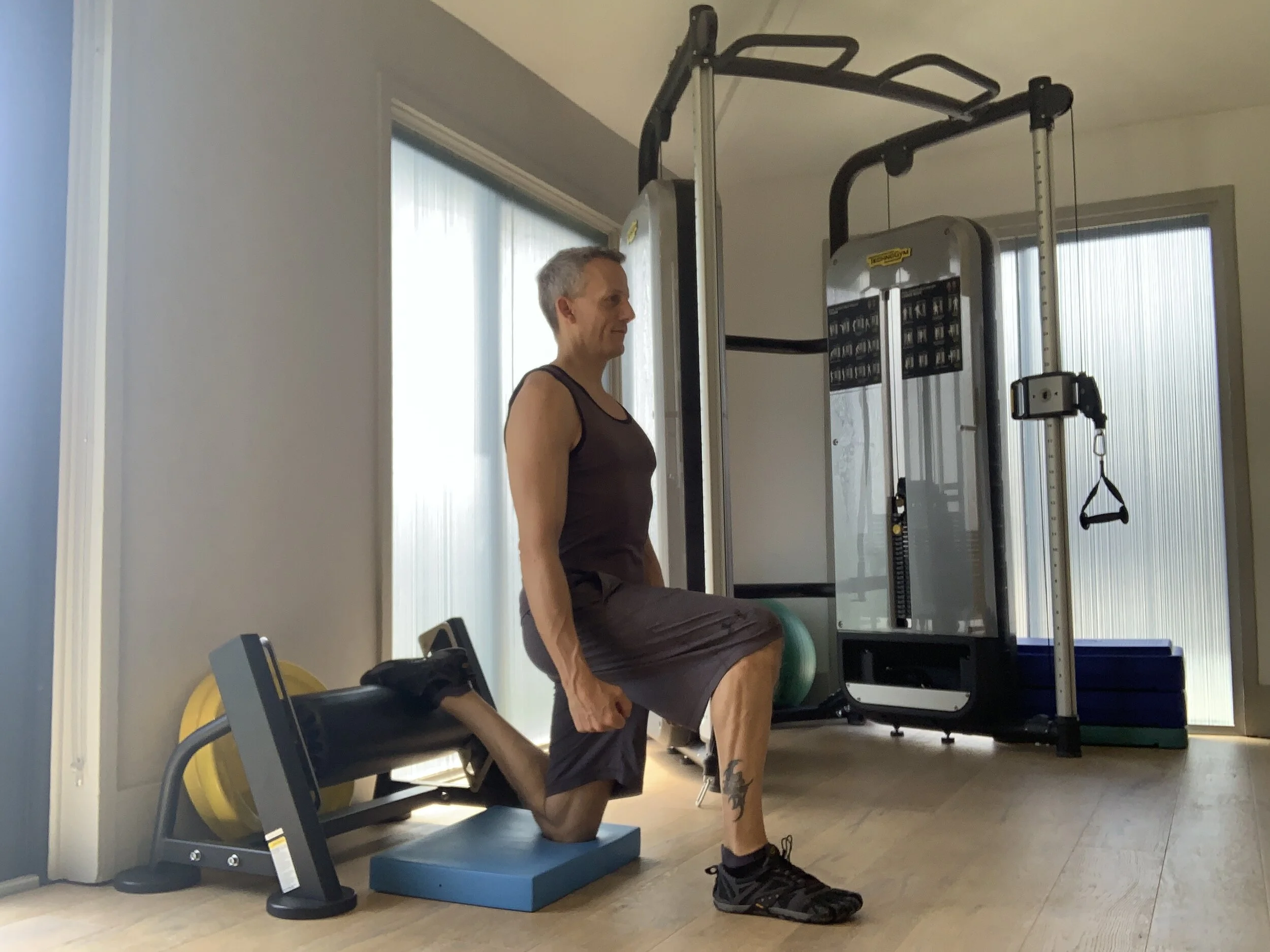
CONTRACT the glutes with the Split Squat W/Front Foot Dorsiflexed variation. This will undoubtedly expose balance issues. Dorsiflexion should be concurrent with hip and knee flexion if each leg is to produce the same amount of power and avoid injury. If this exercise causes too much instability, regress to the non-dorsiflexed version.
Early in my career I had the pleasure of training a professional hockey player. That summer, trade talks loomed as my client approached the final year of his contract. His goal was to make himself more marketable by earning assistant captain. To do that, he needed to excel in the team’s preseason physical fitness tests.
One of the tests was running a mile in under 7 minutes. The players’ sluggishness was often blamed on offseason debauchery. But running a mile was completely contrary to what players did on the ice, and every coach knows that keeping players on the field or ice longer than their endurance dictates creates scoring chances for the opposing team. This adds credence to the edict: Train slow, be slow.
Halfway through his summer training regimen (consisting of circuits that would cause most a massive stroke), the team hired a new coach that changed the preseason physical fitness tests, especially the run. To build their endurance and power, he proposed the following cardiovascular test for the team:
Sixteen 100-yard sprints each done in under 16 seconds.
With each 16 second sprint, the player had the rest of a minute to recover.
Any sprint done in over 16 seconds was considered a failed test.

Clues on how we ‘should’ train the cardio vascular system are apparent in how kids and dogs play. They never hold back. They push to the brink until forced to recover. This tenacity is missing from steady-state cardio and distance-running.
Evolution designed the cardiovascular system for short-duration, powerful bursts of speed to escape imminent threats. The fight or flight response is adept at avoiding danger because it calculates and initiates escape often before the brain can even weigh-in, and training needs to mimic this or the brain won’t allow faster speed and/or coordination.
A sprint is defined as an all-out-effort, meaning every joint contributes to the burst of energy that although brief in duration, pays bigger dividends than distance cardio. The major difference between sprinting and distance-running is the form one assumes to complete both actions. Sprinting naturally places bodyweight and foot-strike in the balls of the feet and requires full flexion and extension from both the hips and shoulders. Distance-running creates heel-strike, where the ankle is the first contact with the ground. This is believed to cause faulty force absorption, which may lead to greater risk of injury.
To absorb the shock of foot-strike and to react properly to ground force the ideal placement for foot-strike is in the forefoot. But to change from a distance heel-striker to a distance forefoot-striker takes time and forethought. Short distance, all-out-effort, sprints have proven to be an effective change for distance runners in the offseason and is ideal for those seeking to lose fat and not muscle.
To determine which style of cardio is right for you, choose the body you want to emulate; the sprinter on the left, or the marathoner on the right:

To begin a sprint program, each all-out-effort needs adequate recovery time. These are usually presented as ratios and coaches vary in what they consider to be adequate recovery time. Most agree that a 1:1 ratio (10 second sprint with 10 second recovery) isn’t enough. The sprint test for hockey players above is a 3:1 ratio with recovery being 3x higher than the all-out-effort (16 work to 44 recovery). Although not as ideal as an 8:1 ratio, where the athlete has 8x the recovery time to work; 3:1 seems adequate rest for ideal performance.
The StairMill Workout:
Warm-up at recovery speed (level 3 to 5 depending on the machine). Remember, the recovery level should be low enough to give you a chance to be 100% for the next sprint.
At the 5th minute increase the level to 10 for 45 seconds
Recover- at the 7th min increase to 12 for 45 sec
Recover- at the 9th min increase to 14 for 45 sec
Recover- at the 11th min increase to 16 for 30 sec
Recover- at the 13th min increase to 18 for 30 sec
Recover- at the 15th min increase to 20 for 30 sec
Recover- at the 17th min increase to 22 for 20-30 sec
Recover- at the 19th min increase to 24 for 20-30 sec
StepMills vary from brand to brand so adjust levels accordingly.
Progressions: The ratios will be different depending on the sprint. Adding the sled or bungee will add load and strengthen non-loaded speed and efficiency. Try the 10 sec to 30 recovery for 10 sprints to start.
Sled Push
Sled Pull
Transverse Slam
Bungee Sprints
At Meso Fit Boca, we take systematic approaches to things like movement prep to allow us to see progress from workout to workout. The following multi-plane movement preparation and workouts are just examples of how our programming can take you to the next level. The variations below allow you to use these movements as is, or peppered into your current program.

Remembering the planes is easy. If you imagine standing in a hallway where your shoulders almost touch the walls, the movements possible in that hallway happen in the sagittal plane. The coronal plane is best described as any movement possible with walls directly in front and behind you. And the transverse plane is where rotation occurs.
At Meso Fit Boca, we differentiate movements from the spine from movements of the extremities. The joints best suited for flexion, extension, and rotation, are the shoulder and hips, and they should create the majority of movement. That doesn’t mean that movement from the spine is against some unwritten law of physics. Plenty of people move from the spine and never have an injury. We just believe that for longevity, creating maximum power takes a stable spine.
We use Multi Plane Movement Prep before engaging in anything strenuous. This simple series of movements moves you through slow steady stretches and transitions that prepare you for the multi-plane movements below. First, work on moving into each pose after 5 full, deep breaths. Take your time.
Multi Plane Movement Prep:
Multi-Plane Workout:
Sagittal Lunge W/Side Reach- 3 Sets
Coronal-Plane Lunge W/Reach- 3 Sets
Transverse-Plane Lunge W/Reach- 3 Sets
Shuffles- 3 sets
Sagittal Jumps- 3 Sets
Single Leg Sagittal Jumps- 3 Sets
(Should any of these multi-joint exercises create excessive compensatory movement, regress to non-loaded versions)
Progressions:
Multi-Plane Lunge
Single Leg Deadlift W/Side Shifts
Box Jump to Step-down to Reverse Lunge (both sides) to Burpee to Side Lunge (both sides) to Transverse Lunge (both sides)
3 sets each
If the brain is the ultimate authority on how we move, then it stands to reason it will protectively tighten muscles to keep the body from joint actions it deems unsafe. But how the brain incorporates movement and what its preferences are aren’t always clear. But if compensated movement isn’t brought into the collective consciousness, how much can we expect to change?
Fascia can be thought of as fiber optic cable feeding information to the brain, and there are areas it seems to listen to very intently. The core is one of those places.

Training should focus more on the forces that destabilize than asking bodies slowed by the brain to speed back up. But we need more than fastidious interventions to fix dings in the body’s collective chain. At Meso Fit Boca, we consider the ripples dings leave behind that affect the entire system.
When the core is weak, the spine is vulnerable. We train the core to brace and react to destabilizing force. Bucket Theory considers the relationship between the ribcage and pelvis extremely important to training. Since both the ribcage and pelvis resemble buckets, one inverted (rib cage) stacked atop another (pelvis), we need to consider the contents of these buckets to understand why the brain goes to such great lengths to protect them. People sleep fetal because it protects the contents of these buckets, and slouching may be a protective method in the absence of core strength.


Strong core’s keep the ribs and pelvis stacked and aligned while the extremities perform reach movements. The brain green-lights all movement when the buckets align, stabilize, and create a solid torso. The core is a reflex. Drawing in, pulling the belly button toward the spine, or any other miscue pertaining to ‘setting’ the core prior to moving is incorrect. The core needs to react, not prepare. No one has dictated which joint action should be stronger; or whether the mirror opposite joint actions should be of equal strength. But from the brain’s perspective there are only two joint actions of note, reach and withdrawal, and the brain uses the core to manage both.
To reach high-hanging fruit requires length, but also the power to withdraw reach quickly should reach become perilous. The core functions as intermediary between ribcage and pelvis while the extremities move away from the spine or midline.
Bucket Theory looks at how the body creates and manages forces the world enacts on us. If torso stability is compromised, spinal rotation replaces the joint actions more suited to create movement. This creates shearing forces in vertebral disks and leads to eventual degeneration. Until silly putty is repurposed as a suitable disk replacement, we should work hard to keep the spine stable and let the extremities do their job.
Reach exposes. Withdrawal protects.
So it stands to reason withdrawal should be the focus of strength training. At Meso Fit Boca, our Signature Series of exercises elicits an adductive response, and therefore, a core response from all our exercises. We believe if the core isn’t involved in every exercise, it can hardly be incorporated into collective movements like walking outside of training.
It’s important to note that balance comes from the brain, not muscles. The inner ear protects us from falling forward with an errant alert system that reels you back the instant you lean forward. This is an important system to manipulate in training because prone position (plank and push-up) loads the core and forces it to brace the spine. But these bracing positions do not tax the obliques as effectively as they could. We need to add a rotational component to prone position to incorporate the obliques.

Looking at fiber direction, the obliques are ideally positioned to prevent torso rotation. There is also sufficient evidence to support the idea the obliques are uniquely connected to the opposing adductor muscles (See Anterior And Posterior Slings). This begs us to consider diagonal patterns as the ideal patterns to strengthen.
Undoubtedly, one diagonal pattern is weaker than the other. To assess this, get into push-up position and try to place all your weight into the right hand and left foot and lift the opposing sides off the floor. If you instantly loose balance, there’s instability in the pattern. Now try the other side. This is one of the reasons to advocate using the non-dominant hand as much as possible outside the gym. Strengthening the weaker diagonal pattern takes precedence over all else if the system is to progress.
Diagonal Pattern Holds:

Very important things happen when considering abduction an exploratory joint action like moving your foot along ice to test it. If the ice cracks and splits, the body needs to withdraw the foot quickly. The protective action of adduction should be as powerful and fast as possible, even spring like. This was evolution’s brilliant adaptation to earth’s terrain that grants the body unlimited reach with powerful withdrawal so we can retreat should the earth fight back. This is why adduction is inherently stronger than abduction.
More amazingly, every time you adduct, the core fires. This powerful coupling adds credence to the idea that adduction should remain a lasting, powerful, force or the brain will shrink your world. Yes, length is important, but if length gained is at the expense of the ability to reign it back, length becomes arduous.
Present the torso as a single, solid structure, and the hip and shoulder joints can manage any destabilizing force. Present the world an improperly trained core, one pretensed (set) before movement, and the brain’s ability to manage and properly distribute force is compromised. So the brain scratches all the activities that require a strong torso, including bucket list items.
The Bucket Workout:
Diagonal Pattern Holds
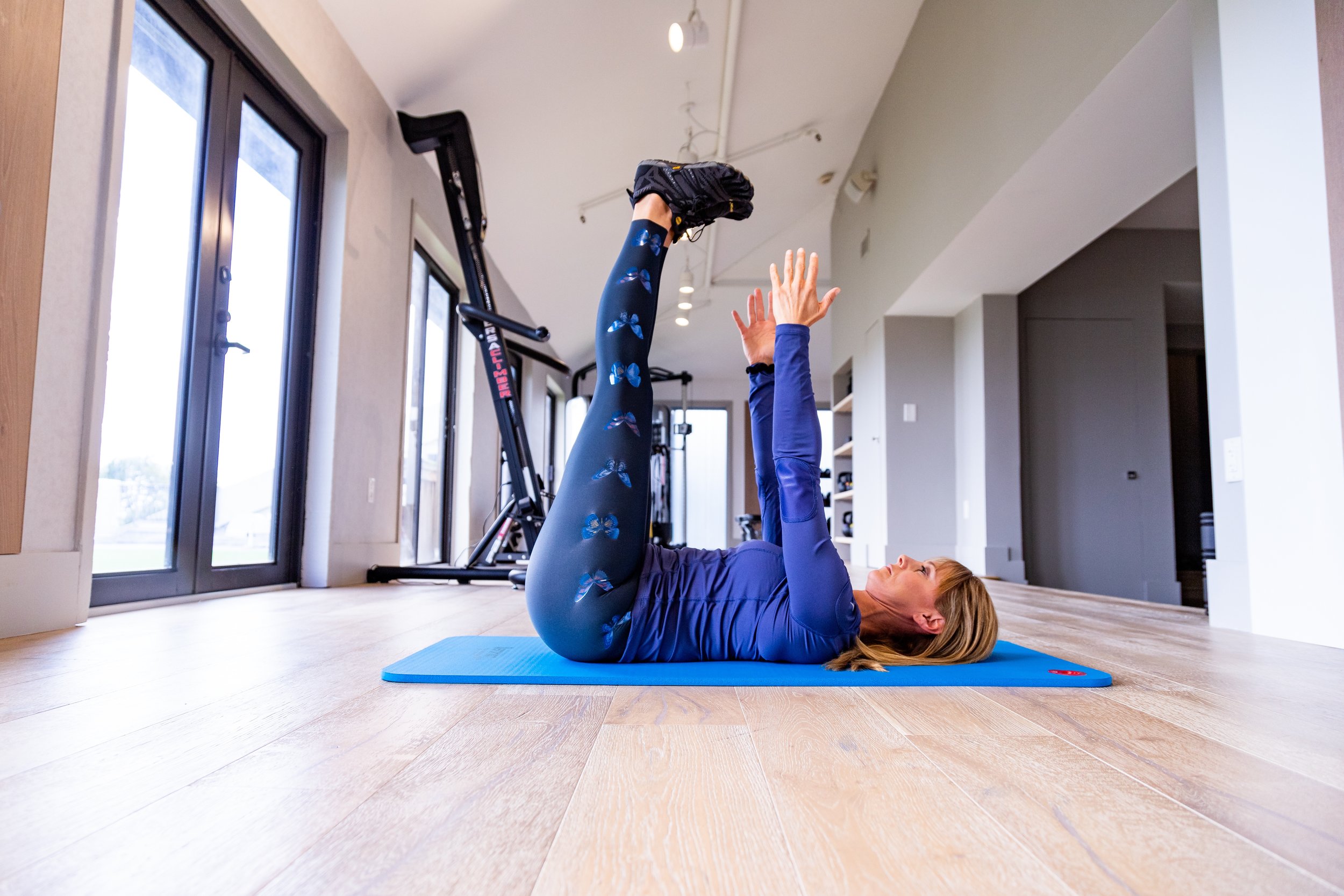
Deadbugs
Supine Rear Laterals
Prone Pullovers
Prone Rear Laterals


At Meso Fit Boca, we didn’t come up with a new way to squat, deadlift, or pushup.
We created exercises that include the brain in the quest for brawn.
We believe that the loss of function associated with aging is really a system wide breakdown caused by misalignment. And by aging, we mean merely getting older, as we’ve seen movement dysfunction in clients as early as 13 years old. This is why we cannot continue to ask bodies to perform without regular check-ups for signs of movement dysfunction. These bodies still produce movement, and some of them do so exquisitely. But we also believe that to correct this, we have to measure the associated loss of equilibrium that comes with the repetitive movements caused by sport and life.
The more profound the difference between the non-dominant and dominant sides of the body show that the body isn’t in need of MORE exercise, it needs careful attention to restoring lost power (see Absolute Power). Our 4-phase system allows each client to proceed with the knowledge that our programming cleared enough movement restrictions to allow it to proceed into more challenging phases. Our pinnacle so called “5th phase” is reassessment that allow us to build on past successes.

Our Signature Series of exercises comply with what we theorize is the brain’s Modus Operandi, which is to move clients through their worlds unharmed. We say ‘their worlds’ because until we understand the movements clients perform thousands of times a day, we’ll be of little help in improving their lives. Anyone trainers can apply more exercise, but RAMP certified trainers assess every client to ensure they apply the correct interventions to the parts of the body in most need. Once that proves fruitful, we seal in those improvements, so that our clients can explore more.
Clients don’t just have a better understanding of their body, they report more mobility moving around hectic days. And when they need to hit the gas because some days requires it, they have more throttle. Other theories center on how to tax an existing movement system. We strive to improve every clients’ movement capacity before we apply exercise, because exercise won’t work without increasing overall ability.
Think of each RAMP phase (Restore-Align-Maintain-Progress) as a way to categorize movement ability. Restoration allows us to bring the body back to its middle. Then we align the body with exercises that re-pattern the brain and allow it to move in the new space created in restoration. Once these goals are maintained, the brain allows greater expressions of movement.
Below is a sneak peak at one of our Signature Series exercises, The Lateral Push Up Walk version 1. We design and use each exercise based on how easily it is either regressed, for people lacking full extension, and it lends itself to multiple progressions. All of The Signature Series exercises are designed specifically to match each of the phases, and all are able to be progressed in suit with our goal of constant improvement.


